Thursday, October 29, 2009
Calvinism, According to Custardy
I like this guy's explanation of TULIP: http://custardy.blogspot.com/2009/10/calvinism.html. Of the few who read my blog, I think the majority are Reformed. What do you all think of it?

Saturday, August 08, 2009
Essays!
Here's some recommended reading; several essays, articles & such that I've read at one time or another and found to be especially illuminating or memorable:
The Problem With Music, by Steve Albini
An enlightening look at the relationship between new bands and record labels. I used to want to be a rock musician. This essay confirmed to me that I should be an indie rock musician, if anything. I eventually gave that up because there was no money in it and I didn't have the ability or motivation to write songs, but that's another thing.
I, Pencil, by Leonard E. Read
A testament to the creative power of free market economies.
Fern-Seed and Elephants, by C.S. Lewis
C.S. Lewis, as a literary critic, rips on the methods of some Biblical critics.
The Special Theory of Relativity, by Richard Feynman
This is best explanation of Special Relativity I've ever encountered. I think that is because 1. He starts with Newton's physics, which I understand, and compares it to Special Relativity, and 2.
He uses math. Math is hard and boring and scary, so some explanations try to avoid it, relying on imagination alone, and fail miserably. Maybe because modern physical theories are mathematical statements. Don't fight it! Give in to the algebra. Listen to the calculus.
Parkinson's Law, by C. Northcote Parkinson
On second reading, I think the title is immodest and the article is a bit tongue-in-cheek, but it's nonetheless convincing. I bet Parkinson's Law applies to corporate managers, but it's counteracted by the fact that laying off excess managerial staff is a good way to cut costs.
The Myth of Sisyphus, by Albert Camus
I generally like the famous existentialist writers, even though I disagree with them on some very basic things. Maybe it's because we ask the same questions, though we accept different answers. This essay has popped into my mind many times since I first read it years ago.
G.K. Chesterton
Chesterton gets his own section. He's sophistical at times, but his insight and his humor are priceless. These are a few of my favorites.
The Problem With Music, by Steve Albini
An enlightening look at the relationship between new bands and record labels. I used to want to be a rock musician. This essay confirmed to me that I should be an indie rock musician, if anything. I eventually gave that up because there was no money in it and I didn't have the ability or motivation to write songs, but that's another thing.
I, Pencil, by Leonard E. Read
A testament to the creative power of free market economies.
Fern-Seed and Elephants, by C.S. Lewis
C.S. Lewis, as a literary critic, rips on the methods of some Biblical critics.
The Special Theory of Relativity, by Richard Feynman
This is best explanation of Special Relativity I've ever encountered. I think that is because 1. He starts with Newton's physics, which I understand, and compares it to Special Relativity, and 2.
He uses math. Math is hard and boring and scary, so some explanations try to avoid it, relying on imagination alone, and fail miserably. Maybe because modern physical theories are mathematical statements. Don't fight it! Give in to the algebra. Listen to the calculus.
Parkinson's Law, by C. Northcote Parkinson
On second reading, I think the title is immodest and the article is a bit tongue-in-cheek, but it's nonetheless convincing. I bet Parkinson's Law applies to corporate managers, but it's counteracted by the fact that laying off excess managerial staff is a good way to cut costs.
The Myth of Sisyphus, by Albert Camus
I generally like the famous existentialist writers, even though I disagree with them on some very basic things. Maybe it's because we ask the same questions, though we accept different answers. This essay has popped into my mind many times since I first read it years ago.
G.K. Chesterton
Chesterton gets his own section. He's sophistical at times, but his insight and his humor are priceless. These are a few of my favorites.
Thursday, July 02, 2009
Alternative Hexadecimal Digits
I'm not complaining about the convention of using characters 0-9 and A-F as hexadecimal digits. It's a good system; it's easy to learn, since most of us in the Western World have known the meaning of 0-9 and the order of the alphabet since childhood. But what if we could start over with only practical concerns (apart from the value of keeping a well-recognized and heavily-used convention) to guide us?
I can think of a few desirable traits for a set of hexadecimal digits:
In handwritten form:
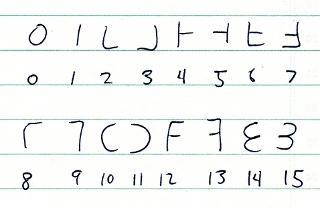 For LCD/LED displays:

Description of This Alternative
First off, the digits for zero and one are the same as in conventional binary, octal, and decimal.
Next, a definition: the binary composition of a number is the set of integral powers of 2 that add up to that number. For example, the binary composition of 76 is the set {64, 8, 4} or {26, 23, 22}, since its members are integral powers of 2 and they add to 76.
With this definition in mind, the following are true of the alternative digit for a given number 1-15:
Some Benefits of This Alternative
Because of these rules, if a hexadecimal digit is depicting a nibble of memory (e.g. in a hex dump program), one only has to look at a certain part of the digit to see if a particular bit is set to 1 or 0. Also, those of you who know about electronic logic gates can tell that the circuitry needed to take a four-bit input representing a number and light up the proper parts of an LED/LCD digit display would be a bit simpler these digits than with the conventional digits.
Update: I've been collaborating with Valdis Vītoliņš on a new set of alternative hexadecimal digits. They are an improvement on the digits described in this post. See this blog post.
I can think of a few desirable traits for a set of hexadecimal digits:
- They should be easy to learn.
- It should be easy to write them by hand quickly without them being ambiguous or difficult to read.
- They should be representable using the common LCD/LED displays used in clocks, calculators, etc.
- They should depict their binary counterparts somehow. In software, we must sometimes translate between hexadecimal and binary, e.g. to determine whether a given bit in a given word is 1 or 0. If the oneness or zero-ness of each bit in a nibble was visibly represented in its corresponding digit, this translation would be easier.
In handwritten form:
For LCD/LED displays:Description of This Alternative
First off, the digits for zero and one are the same as in conventional binary, octal, and decimal.
Next, a definition: the binary composition of a number is the set of integral powers of 2 that add up to that number. For example, the binary composition of 76 is the set {64, 8, 4} or {26, 23, 22}, since its members are integral powers of 2 and they add to 76.
With this definition in mind, the following are true of the alternative digit for a given number 1-15:
- If one is part of a number's binary decomposition, its digit faces right otherwise it faces left. Equivalently, the digits for even numbers face the same direction as 'e' and 'n', and the digits for odd numbers face the same direction as 'd'.
- The digit has a stroke across its base if and only if two is part of the number's binary composition.
- The digit has a stroke across its middle if and only if four is part of the number's binary composition.
- The digit has a stroke across its top if and only if eight is part of the number's binary composition.
Some Benefits of This Alternative
Because of these rules, if a hexadecimal digit is depicting a nibble of memory (e.g. in a hex dump program), one only has to look at a certain part of the digit to see if a particular bit is set to 1 or 0. Also, those of you who know about electronic logic gates can tell that the circuitry needed to take a four-bit input representing a number and light up the proper parts of an LED/LCD digit display would be a bit simpler these digits than with the conventional digits.
Update: I've been collaborating with Valdis Vītoliņš on a new set of alternative hexadecimal digits. They are an improvement on the digits described in this post. See this blog post.
Sunday, June 21, 2009
Spice Rack
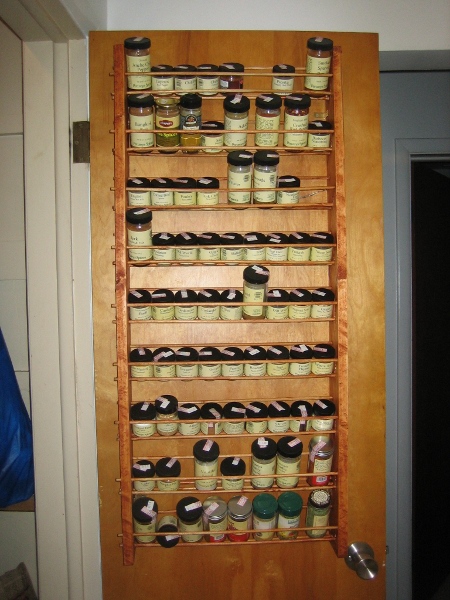
Parts:
- 2 boards: 36" long and about 3-1/2"
- 23 dowels: 36" long and 1/4" diameter
- 4 metal angle brackets
- Mallet
- Drill
- 30/60/90 triangle (like for geometry class)
- Ruler or tape measure
- C-clamps
- 1/4" wood drill bit
- Small drill bit (for pre-drilling screw holes)
- Screwdriver
- Saw (and a saw box, if you have one)
- Level
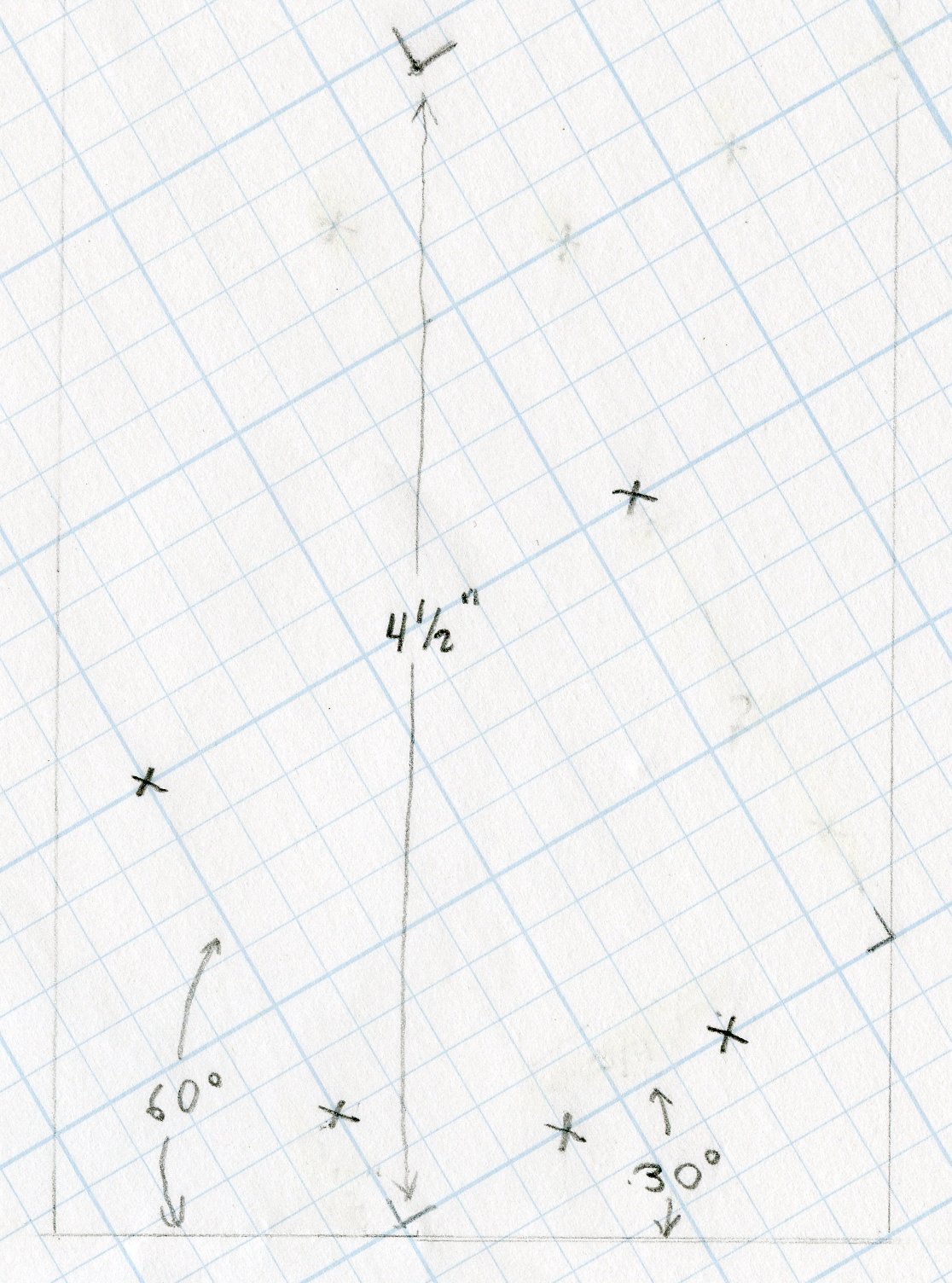
- On the pattern below, the X's represent the centers of drill holes. Each small square is 1/4" long. Draw this pattern onto the end of one of the boards using the 30/60/90 triangle. The left side of the diagram corresponds to the front side of the spice rack.
- Repeat the pattern 4-1/2" apart for each row in the rack.
- Clamp the two boards together with the drawn pattern visible on top.
- Drill 1/4" holes centered on each X drawn.
- Saw the dowels in half.
- Stain or paint the boards and dowels, if you want to.
- Pound the dowels into the drill holes.
- Screw the angle brackets onto the boards so they are flush with the back of the spice rack.
- Screw the angle brackets onto the door. Make it level, of course.
Notes:
- Make sure hole for the dowels are drilled at a straight 90 degrees, so the dowels don't go in crooked.
- When drilling holes through the two boards, press some scrap wood against where the drill bit will go out the other side, to prevent the bottom board from splintering.
- If the dowels are are the same size or bigger than the holes, you won't need glue to hold the rack together.
- It's easier to stain the rack before putting it together than after.
Thursday, June 04, 2009
Somebody's Wrong
- Fact: I say someone is wrong about something.
- It follows then that someone is wrong about something. This is proven indirectly:
- Assume everyone is correct about everything. If so, then the statement I have made in (1) is wrong.
- Since the statement I made in (1) is wrong, someone is wrong about something.
- (2.1) and (2.2) contradict each other.
Therefore, someone is wrong about something. - Furthermore, that wrong idea is not what I said in statement (1). Proof of this is as follows:
- (2) proves that someone is wrong about something.
- Since someone is wrong about something, my statement that someone is wrong about something is true and thus not wrong.
Therefore, there is at least one wrong idea held by at least one person, and it is not my statement that someone is wrong about something.
Sunday, May 31, 2009
Samuel Johnson's A Journey to the Western Islands of Scotland in Google Earth
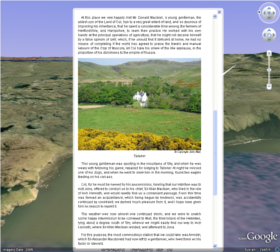
Here it is, finally, after talking about it so much. I've mapped Samuel Johnson's A Journey to the Western Islands of Scotland in Google Earth. You can download it either as a KMZ or as a KML file. The KML file is much smaller, but it will load more slowly since the images it uses are online rather than embedded in the file. I recommend using the KMZ file.
I welcome corrections and additions, especially with regards to the identification of places and landmarks, so long as a rationale is given. I'm no historian, but I would like to make this thing accurate.
I welcome corrections and additions, especially with regards to the identification of places and landmarks, so long as a rationale is given. I'm no historian, but I would like to make this thing accurate.
Monday, December 22, 2008
Chesterton in London
My wife and I recently had the pleasure of visiting London a couple months ago. I am a huge G.K. Chesterton fan (note the title of my blog), who was a lifelong Londoner, so I thought it would be fun to see a few things around London mentioned in Chesterton's books. I think the idea started with me wondering what Leicester Square looked like after reading The Man Who Was Thursday, in which a secret society of anarchists meets publicly on a balcony overlooking it. I chose three things to find in London: balconies in Leicester Square, The Mask of Memnon and the top of St. Paul's Cathedral, and I happy to say that we managed to see and get pictures of all three in and amongst all the sights and locations we saw in London.
Chesterton, of course, loved paradox both as a rhetorical tool and a plot device, thus we read of Gregory, the anarchist explaining his society's actions as follows:

 It isn't difficult to imagine a child with Chesterton's active imagination being frightened by this face staring down at them.


I'd better tell you that he is carrying out his notion of concealing ourselves by not concealing ourselves to the most extraordinary lengths just now. Originally, of course, we met in a cell underground, just as your branch does. Then Sunday made us take a private room at an ordinary restaurant. He said that if you didn't seem to be hiding nobody hunted you out. Well, he is the only man on earth, I know; but sometimes I really think that his huge brain is going a little mad in its old age. For now we flaunt ourselves before the public. We have our breakfast on a balcony--on a balcony, if you please--overlooking Leicester Square."We passed through Leicester Square in between our visit to Westerminster Abbey and the National Art Gallery. It is indeed a very public place, now being the center of London's theatrical activity. There we found a likely inspiration for the location of the anarchist's public meeting in The Queen's House.
"And what do the people say?" asked Syme.
"It's quite simple what they say," answered his guide.
"They say we are a lot of jolly gentlemen who pretend they are anarchists."
"It seems to me a very clever idea," said Syme.
"Clever! God blast your impudence! Clever!" cried out the other in a sudden, shrill voice which was as startling and discordant as his crooked smile. "When you've seen Sunday for a split second you'll leave off calling him clever."
With this they emerged out of a narrow street, and saw the early sunlight filling Leicester Square. It will never be known, I suppose, why this square itself should look so alien and in some ways so continental. It will never be known whether it was the foreign look that attracted the foreigners or the foreigners who gave it the foreign look. But on this particular morning the effect seemed singularly bright and clear. Between the open square and the sunlit leaves and the statue and the Saracenic outlines of the Alhambra, it looked the replica of some French or even Spanish public place. And this effect increased in Syme the sensation, which in many shapes he had had through the whole adventure, the eerie sensation of having strayed into a new world. As a fact, he had bought bad cigars round Leicester Square ever since he was a boy. But as he turned that corner, and saw the trees and the Moorish cupolas, he could have sworn that he was turning into an unknown Place de something or other in some foreign town.
At one corner of the square there projected a kind of angle of a prosperous but quiet hotel, the bulk of which belonged to a street behind. In the wall there was one large French window, probably the window of a large coffee-room; and outside this window, almost literally overhanging the square, was a formidably buttressed balcony, big enough to contain a dining-table. In fact, it did contain a dining-table, or more strictly a breakfast-table; and round the breakfast-table, glowing in the sunlight and evident to the street, were a group of noisy and talkative men, all dressed in the insolence of fashion, with white waistcoats and expensive button-holes. Some of their jokes could almost be heard across the square. Then the grave Secretary gave his unnatural smile, and Syme knew that this boisterous breakfast party was the secret conclave of the European Dynamiters.

It stands at the northeast corner of the square. Of several balconies overlooking the square, this is the only one old enough to be around at the turn of the century, large enough to hold a dining table for seven, and buttressed enough to be called "formidably buttressed". It also happens to face southward, so the morning sun does shine on it. It doesn't match Chesterton's description exactly, though, since there are four French doors rather than one. Perhaps the balcony on the first floor was a later edition. Or perhaps Chesterton didn't intend for his balcony to match any real location exactly.
The passage in The Man Who Was Thursday goes on to describe the horrifying presence of Sunday, ending with Syme seeing his face for the first time:
The form it took was a childish and yet hateful fancy. As he walked across the inner room towards the balcony, the large face of Sunday grew larger and larger; and Syme was gripped with a fear that when he was quite close the face would be too big to be possible, and that he would scream aloud. He remembered that as a child he would not look at the mask of Memnon in the British Museum, because it was a face, and so large.
As near as I can tell, the "mask of Memnon" to which Chesterton was referring is a colossal bust of Ramses II which was at one time named The Younger Memnon. Accoring to Greek myth, Memnon was a king of Ethiopia. The Greeks named quite a few things they around Thebes after him, including the Memnonium, two statues, and The Younger Memnon, which was one of the first colossal Egyptian artifacts taken to the British Museum, and apparently quite famous in its time. It wasn't the only colossal likeness of a pharaoh housed in the British Museum in Chesterton's time, but so long as Chesterton didn't confuse it with another similar statue, then this is the one. Here's a picture I took:
 It isn't difficult to imagine a child with Chesterton's active imagination being frightened by this face staring down at them.
Perhaps the most memorable of all of Chesterton's London references is at the opening of The Ball and The Cross, where the monk Michael is stranded on the cross at the top of St. Paul's Cathedral by a mad scientist suggestively named Lucifier after they argue about philosophy, as so many of Chesterton's characters do:
Father Michael in spite of his years, and in spite of his asceticism (or because of it, for all I know), was a very healthy and happy old gentleman. And as he swung on a bar above the sickening emptiness of air, he realized, with that sort of dead detachment which belongs to the brains of those in peril, the deathless and hopeless contradiction which is involved in the mere idea of courage. He was a happy and healthy old gentleman and therefore he was quite careless about it. And he felt as every man feels in the taut moment of such terror that his chief danger was terror itself; his only possible strength would be a coolness amounting to carelessness, a carelessness amounting almost to a suicidal swagger. His one wild chance of coming out safely would be in not too desperately desiring to be safe. There might be footholds down that awful facade, if only he could not care whether they were footholds or no. If he were foolhardy he might escape; if he were wise he would stop where he was till he dropped from the cross like a stone. And this antinomy kept on repeating itself in his mind, a contradiction as large and staring as the immense contradiction of the Cross; he remembered having often heard the words, "Whosoever shall lose his life the same shall save it." He remembered with a sort of strange pity that this had always been made to mean that whoever lost his physical life should save his spiritual life. Now he knew the truth that is known to all fighters, and hunters, and climbers of cliffs. He knew that even his animal life could only be saved by a considerable readiness to lose it.
Some will think it improbable that a human soul swinging desperately in mid-air should think about philosophical inconsistencies. But such extreme states are dangerous things to dogmatize about. Frequently they produce a certain useless and joyless activity of the mere intellect, thought not only divorced from hope but even from desire. And if it is impossible to dogmatize about such states, it is still more impossible to describe them. To this spasm of sanity and clarity in Michael's mind succeeded a spasm of the elemental terror; the terror of the animal in us which regards the whole universe as its enemy; which, when it is victorious, has no pity, and so, when it is defeated has no imaginable hope. Of that ten minutes of terror it is not possible to speak in human words. But then again in that damnable darkness there began to grow a strange dawn as of grey and pale silver. And of this ultimate resignation or certainty it is even less possible to write; it is something stranger
than hell itself; it is perhaps the last of the secrets of God. At the highest crisis of some incurable anguish there will suddenly fall upon the man the stillness of an insane contentment. It is not hope, for hope is broken and romantic and concerned
with the future; this is complete and of the present. It is not faith, for faith by its very nature is fierce, and as it were at once doubtful and defiant; but this is simply a satisfaction. It is not knowledge, for the intellect seems to have no particular part
in it. Nor is it (as the modern idiots would certainly say it is) a mere numbness or negative paralysis of the powers of grief. It is not negative in the least; it is as positive as good news. In some sense, indeed, it is good news. It seems almost as if there were some equality among things, some balance in all possible contingencies which we are not permitted to know lest we should learn indifference to good and evil, but which is sometimes shown to us for an instant as a last aid in our last agony.
Michael certainly could not have given any sort of rational account of this vast unmeaning satisfaction which soaked through him and filled him to the brim. He felt with a sort of half-witted lucidity that the cross was there, and the ball was there, and the dome was there, that he was going to climb down from them, and that he did not mind in the least whether he was killed or not. This mysterious mood lasted long enough to start him on his dreadful descent and to force him to continue it. But six times before he reached the highest of the outer galleries terror had returned on him like a flying storm of darkness and thunder. By the time he had reached that place of safety he almost felt (as in some impossible fit of drunkenness) that he had two heads; one was calm, careless, and efficient; the other saw the danger like a deadly map, was wise, careful, and useless. He had fancied that he would have to let himself vertically down the face of the whole building. When he dropped into the upper gallery he still felt as far from the terrestrial globe as if he had only dropped from the sun to the moon.
The upper gallery of which Chesterton writes is the Golden Gallery, which is behind the iron railing just above the dome, as can be seen in this picture:

Currently, anyone can climb the five hundred-odd stairs up to it on paying admission to St. Paul's. The view of London from the gallery is well worth the climb (and makes going to St. Paul's an excellent alternative to the painfully expensive London Eye), and the vertigo induced by looking up to the top from up close makes reading about Michael's descent even more exciting. After close inspection I'm not sure that Michael could have found a foothold between the rim immediately below the cupola and the gallery, since it overhangs the stonework beneath it so much, but if he didn't, he would have had to have made his finally drop about twenty feet directly onto the gallery floor, which would seem almost impossible for an old man to do without breaking something. Perhaps Chesterton was aware of this, or perhaps not. I wonder if he had even climbed to the top of St. Paul's when he wrote this. Chesterton was dangerously overweight for much of his life, so I wouldn't be surprised if he was not eager to climb such a large number of stairs. The picture below is of my wife standing on the Golden Gallery. It kind of almost shows what it's like to look upward to the top.

Subscribe to:
Posts (Atom)

 Posts
Posts


